
Setting Boundaries
I recently discussed how too much freedom is probably the leading cause of behavioural issues in dogs.I’d like to talk about how to prevent the issues that arise with too much freedom and how to set appropriate boundaries.We all need boundaries. It’s a fact of life. If we don’t know where the boundaries are, how can we—or our dogs in this case—understand what is acceptable and what isn’t? Lack of consistent boundaries can lead to confusion, especially if certain behaviours are allowed as puppies and then lead to being scolded later in life due to safety or welfare concerns, or distress when not being able to exhibit behaviours usually allowed under different circumstances. Dogs can contextualise situations, meaning they know that certain things happen one way in specific contexts and differently in others. However, these boundaries still need to be learned.It’s generally easier to relax the rules as your dog matures and has already learnt to behave appropriately than to try to establish boundaries that have been non-existent for the first months of living with a family. As those who’ve trained with me know, I enjoy using analogies to explain behaviour and socialisation. For instance, implementing a boundary with two six-year-olds giggling in the corner during art class would differ significantly from addressing five 22-year-old tradies who haven’t shown up for work on a Monday for the sixth time due to hangovers!. In both cases, you would begin with gentle boundaries—using interruption, communication according to their understanding, redirection, and rewards for the correct behaviour— This would probably work immediately for the 6 year olds, however, with the older set, who this has already failed with and who already know what is unacceptable, you would escalate to more serious, possibly aversive measures. This would still be done in increments. A common behavioural issue due to a lack of early boundaries is when dogs get overly excited as someone comes to the door, or when they drag their owners to meet other dogs or people while on walks.For the first few months of a puppy’s life in its new home, visitors probably come by frequently to admire the adorable new addition, resulting in a lot of stimulation—petting, treats, and cuddles. With all this attention, the puppy learns that jumping and being overly excited at the door is a way to receive attention. As the puppy grows older and the novelty wears off, this overexcitement becomes problematic. Clients often say, “My dog misbehaves because it jumps all over everyone who comes to the house.” If I had ten pounds for every time I heard this, I could afford a new van! However, when I explain the reasons behind the behaviour, it becomes clear that we have inadvertently taught the puppy to act this way due to a lack of rules regarding greeting visitors and other dogs from the outset. If we could train our dogs as consistently and effectively as we inadvertently do when it comes to excitement at the door, we would all be excellent dog trainers! Once new rules, protocols, and boundaries are established, the behaviour can change, and the issue of overexcitement is resolved. However, we should never jump directly to punishment for this behaviour. The dog typically does not even realise it shouldn’t be acting this way, and we have actively encouraged it. Considerations for Implementing Boundaries with Dogs 1. **Understanding the Dog’s Knowledge**: Assess the dog’s level of comprehension regarding what you’re asking. Is this behaviour something the dog is encountering for the first time, whether as a normal environmental behaviour or a response to a command? 2. **Behavioural Training**: Are you teaching a new command or altering an existing behaviour? Has the dog been fully trained and proofed, or is this a behaviour you have been modifying for some time? 3. **Approach to Setting Boundaries**: Establishing boundaries should not be aggressive, prolonged, or frightening. Instead, they should mainly involve interruption and redirection, followed by a reward for the desired behaviour. However, the interruptions may need to be stronger as a dog matures and realises there is more reward for following a behaviour they have a strong drive for. We can’t ‘out reward’ every behaviour! 4. **Gentle Learning**: Boundaries don’t need to be scary or painful. Other Factors Influencing Dog Behaviour 1. **Genetic Predisposition**: Certain breeds are predisposed to specific behaviours, such as aggression or anxiety. 2. **Maternal influences,** including the mother’s health and behaviour during pregnancy and while rearing pups, can impact a puppy’s temperament. 3. **Early Socialisation**: Lack of appropriate socialisation during puppyhood can result in fear, anxiety, and aggression in adulthood. Adverse experiences during this critical period can lead to behavioural problems, even in otherwise well-socialised dogs. 4. **Environmental Factors**: Stressful changes and traumatic events, such as accidents, attacks, or abuse, can contribute to behavioural issues, including fear or aggression. 5. **Medical Conditions**: Physical ailments like pain, allergies, or hormonal imbalances(e.g., hypothyroidism) can cause irritability, aggression, or other behavioural changes. It is important to rule out medical causes before attributing behavioural issues to other factors. 6. **Additional Factors**: Boredom and a lack of stimulation can lead to destructive behaviours. Miscommunication between the owner and the dog can also result in undesirable actions. By understanding these potential causes, dog owners can take proactive steps to address behavioural issues. This includes appropriate boundaries from the beginning, early socialisation, consistent training, seeking veterinary care for medical conditions, and addressing environmental stressors.
What’s the biggest cause of behavioural and training issues……..?

Too Much Freedom What is ‘too much freedom’? t’s allowing them access to areas or activities they are not ready for, potentially leading to undesirable habits and allowing them to learn bad habits before they’ve learned the rules. While restriction is essential, balancing it with exposure to a wide range of environments and situations, using positive reinforcement and enrichment activities, is crucial to emotionally, mentally, and physically stimulating a dog. What are some of the common issues arising from excessive freedom? It can result in an inappropriately socialised dog that has trouble with impulse control and does not understand boundaries, leading to problems like destructive or reactive behaviour. 1. They may have inappropriate and dangerous socialisation experiences, potentially leading to fear or aggression when encountering new situations or people later on. 2. Or, alternatively, they can become over-socialised,resulting in poor impulse control around people and other dogs, becoming a nuisanceand causing issues for themselves and others. 3. Establishing clear boundaries and training basic commands can be harder once dogs have self-rewarded with unwanted behaviours and experiences (such as running off after scents, jumping on people or furniture, stealing food, etc.). 4. Excessive barking 5. ‘Stealing’ items in the home and destructive behaviour 6. Poor recall and the dangers of chasing wildlife, resulting in getting lost or injured. Finding the Sweet Spot It’s about providing a safe and predictable environment where a dog can learn and grow rather than being overwhelmed by unchecked choices. Limiting a dog’s access to certain areas, environments, and objects and providing a clear routine and expectations for their behaviour results in a confident, well-mannered dog. If a dog is expected to make too many decisions without boundaries and guidance, it can result in frustration on both sides of the human/dog relationship. Proper structure ensures a dog sees the family as a safe place and the provider of fun and freedom. Creating mutual trust and confidence Teaching Self-Control Limits and guidelines are crucial for our dogs’ development. They provide structure, predictability, and a framework for learning, leading to a well-adjusted and confident dog. Without clear expectations, dogs can become anxious, confused, and even exhibit undesirable behaviours as they struggle to understand their place and role within their environment. Here’s a more detailed look at why limits and guidelines are so important: 1. Structure and Predictability: Dogs thrive on routine and predictability. Knowing what is expected of them reduces stress and anxiety, as they don’t have to constantly guess what behaviour is appropriate. Establish clear boundaries and rules for basic needs like feeding, walks, and bathroom breaks, as well as for interactions with family members and other animals. A structured environment helps dogs develop a sense of security and trust in their humans. 2. Learning and Training: Limits and guidelines are the foundation for training. They help dogs understand what is acceptable and unacceptable behaviour, which is essential for learning commands and developing good manners. Consistent and positive reinforcement, such as praise and treats, can effectively shape desired behaviours when coupled with clear expectations. Addressing unwanted behaviours as soon as they occur through interruption and redirection can help guide dogs towards appropriate responses. 3. Social Development and Confidence: Limits and guidelines help dogs learn how to interact appropriately with others, both humans and animals. By setting clear expectations for social behaviours, dogs can develop confidence in navigating social situations without fear or anxiety. Proper socialisation during puppyhood and beyond is crucial for developing a well-adjusted and well-behaved adult dog. 4. Addressing Problem Behaviours: Dogs who don’t clearly understand boundaries may develop problem behaviours like resource guarding, reactivity, or excessive barking. Establishing clear limits and guidelines can help prevent these issues from arising or at least make them easier to manage. A structured approach can also help address existing behavioural problems through techniques like habituation, desensitisation, and counterconditioning. 5. Preventing Unwanted Behaviour and Damage: By confining a dog to a crate or pen during periods of inattention, owners can prevent potential property damage and reduce the likelihood of house-soiling or separation anxiety. Environmental management, such as using baby gates, can also help prevent unwanted behaviours. In essence, limits and guidelines are not about being strict or cruel; they provide a supportive and predictable environment that allows dogs to thrive and develop into well-adjusted, happy companions. Effective techniques for teaching self-control. 1. Using commands and cues 2. Reward-based training methods 3. Gradually increasing freedom as skills improve From Chaos to Calm Strategies to transform unsupervised adventures into positive experiences focus on mental and physical enrichment, positive reinforcement, and gradual desensitisation to new environments. This includes providing interactive toys, scent games, and opportunities to explore different areas under your supervision while praising good behaviours and avoiding punishment. Techniques for creating safe and structured playtime 1. Supervised socialisation with other dogs and people (not mad , over threshold excitement with every dog or person they meet!) 2. Structured walks and training sessions 3. Engaging activities that promote good behaviour A young dog needs a balance between freedom and structure to ensure it gets the most out of its environment and relationships. If you ensure your young dog doesn’t have too much freedom, you can ensure they are a happier, healthier companion. Building a dog-human relationship based on trust and understanding is crucial for a positive and lasting bond. This creates a secure and comfortable environment for your dog, leading to improved behaviour, reduced anxiety, and a stronger overall relationship. When dogs trust you, they are more likely to listen, be eager to please, and seek your guidance, fostering a harmonious partnership.
Dogs & Children
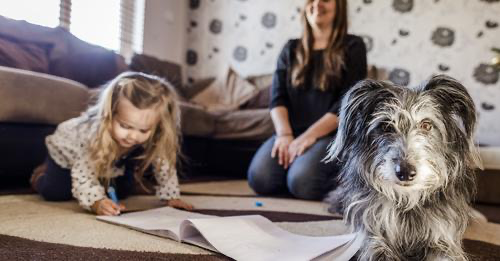
A subject I get asked about a lot is the interaction between dogs and children or babies. Whether that’s a dog already in the family and a new baby coming along or introducing a new dog or puppy to a family with children, especially where the child is younger, say under ten years old. We have all seen Disney films in which dogs and children are best friends, and the dog almost seems to be able to read the child’s mind. Dogs and children can be great together, and having a dog can help children develop kindness, understanding, and respect for living things. Dogs can also be playmates and support. However, the reality can be very different; An adult dog may not have been previously socialised with small children and will often find their noises, movements, energy and unpredictability, frightening. Alternatively, an adult dog will have established communication ‘rules’ and manners and see children’s disregard for these as rude, resulting in dog-appropriate corrections. Or a dog with poor boundaries or a breed that perhaps places high value on food, bed, sofa, or its humans can take offence at the little being’s apparent disregard for these and their body language resulting in them telling the child so. Of course, puppies, like children, have poor self-regulation and knowledge of what is or isn’t appropriate, so they will often get overexcited around small, fast, squeaky children! The majority of issues come down to management—don’t allow your dog or puppy to be alone with small children, and don’t expect your dog or child to know how they should behave, even if you have just told them! · Never leave children unattended with a dog—even for a few minutes! Stay with your children and your dog. Have a management system where your dog has its own cosy spot or space or can possibly be shut out of harm’s way. Stair gates and crates are great for this. · Let sleeping dogs lie—never let children disturb a resting or sleeping dog. Your dog should always have a quiet place to retreat to when needed and teach children not to disturb them when they are in their private spot. · Dogs may protect their toys, bowls, and food, so children should always keep a safe distance. Teach your child not to approach dogs when they’re: Eating or having a treat Have a toy or something else they like Sleeping Unwell, injured or tired Blind or deaf Never let your children approach dogs they don’t know. Always ask the owner if it’s okay for their dog to be petted. ( that goes for you too!) Teach your child to be kind and polite to dogs. Don’t let your child climb on dogs, pull their ears or do anything you wouldn’t allow them to do to another child. Train your dog not to jump up on people. It may be fun when they’re puppies, but that cute pup will grow into a much bigger dog that could seriously injure a small child. Do not allow your children to feed your dog while eating. This can encourage begging behaviours or even food theft from your child’s hand or plate. With the correct boundaries and appropriate lessons on both sides of the species gap your dogs and children will have lots of laughter, fun and love together Find great Blue Cross advice here; Keeping your family dog and visiting children safe | Blue Cross https://www.bluecross.org.uk/advice/dog/keeping-your-family-dog-and-visiting-children-safe
Dog Training Methods and Beliefs- What are the differences?

There is a rich tapestry of methods and philosophies when it comes to dog training and behaviour modification. This diversity may surprise many dog owners, who might have assumed that there is only one way to train a dog. In reality, there are three main training methodologies or “camps” that trainers may align themselves with. Before I list these three groups, it is important to note that within each methodology or “camp,” there is a spectrum. Some professionals may be more extreme in their practice or beliefs. I also want to say that categorising training and behaviour professionals into a specific “camp” has become a hot topic lately because many do not fully agree or identify with each group. Due to the extremisms in each of the dog training “camps,” many professionals feel like outliers because they may see benefits to a variety of training approaches. This blog is not intended to further divide the dog training and behaviour professional community or criticize anyone’s training methods and beliefs. Instead, it is a resource for dog owners, empowering them to make informed decisions about what is best for themselves and their dogs when seeking professional help. The Three Camps In no particular order, the three main training methods are: Positive reinforcement, or force-free. training focuses on teaching the dog what to do, rather than what not to do, and it focuses mainly on reinforcing behaviour we like to teach a dog, using treats, play, praise, environmental rewards or other things the dog finds enjoyable. These trainers avoid the punishment of unwanted behaviours, instead focusing on rewarding wanted behaviours and setting the dog up for success via changes to and management of the environment. This methodology also concentrates heavily on who the dog is as an individual, a dog’s genetic makeup, emotional state and well-being, building trust and creating a deep relationship with a dog. Positive reinforcement-based methods do not include aversive methods or implementing boundaries. Positive reinforcement trainers generally use harnesses, flat collars, and head halters. It is important to note that there are extremes to this group, just like all the other groups. I have observed that those who label themselves “force-free” are generally on the more extreme end of the positive reinforcement methodology. Some trainers within this group do not believe in ever teaching a dog “no” or setting boundaries that could be aversive to the dog. Balanced There is a wide variety of training styles and beliefs within this group. Balanced trainers believe in using positive reinforcement-based techniques. (I find that the really good ones tend to use positive reinforcement techniques in most of their training.) Balanced trainers also believe in using different forms of punishment when necessary to teach, stop, manage or correct behaviour. Balanced training professionals are willing to use a broader range of methods and tools, but this will vary depending on the training professional and what they feel comfortable using. Just like positive reinforcement professionals, balanced professionals use treats, play, praise and environmental rewards to teach and reinforce desirable behaviour. Similarly to positive reinforcement professionals, most balanced professionals focus heavily on who the dog is as an individual, understand the dog’s genetic makeup, and place a heavy emphasis on creating a relationship and connection with a dog. It is important to note that there are extremes to this group, just like all the other groups. For example, some professionals may use punishment more than others believe it is necessary, and some may rely more heavily on positive reinforcement. Correction-based (sometimes referred to as “traditional training” or “coercive training” or “old school training,” especially among the professional dog training community). This is the type of training you see in celebrity dog trainer Cesar Millan’s TV show, especially the early TV shows he had. These training methods generally involve training and modifying behaviour using almost solely corrections and punishment. Trainers from this methodology use little to no reinforcement to teach a dog what to do or how to do it. This methodology does not generally focus on the dog’s emotional wellbeing. Generally, this methodology does not focus much on the dog as an individual being, nor much on developing a deep relationship with a dog. Correction-based methods focus on the concept of “Do it now, damnit” and believe that dogs are trying to be the alpha or dominant, so owners are generally taught how to be the alpha instead. It is important to note that there are extremes to this group, just like all the other groups. Some professionals may be extremely heavy-handed and rely on especially harsh punishments, which can result in additional behaviour issues in dogs. Least Intrusive, Minimally Aversive- LIMA Many professionals fall between positive reinforcement and balanced training methods. Though there isn’t a formal label for this group or “camp,” many follow the philosophy of LIMA (least intrusive, minimally aversive). LIMA takes a more evidence-based and pragmatic approach to assessing the individual dog and family. This allows us to meet the dog and owner where they are. The use of LIMA generally starts with using the least intrusive approach possible for the individual dog and situation. LIMA allows professionals to be objective and critical thinkers who decide when and how to use various training and behaviour modification techniques and interventions based on the individual case and situation. Just like humans, dogs learn, work, and are motivated differently. LIMA lets us decide the best approach and methodology for the dog. Most LIMA-based professionals consider many things in trying to help dogs and their families, which include but are not limited to: The individual dog (who the dog is, including their emotions, their joys, their fears or anxieties, the way they learn etc) The individual family and household The environment The dog’s breed and genetic traits (genetics) Where the owner and dog are at that time (where they are at in training, their relationship, etc.) The training skills, manners, and rules that the dog already knows The amount of time and effort the
How to support a nervous dog

Set Up a Routine Insecure dogs absolutely crave routine. Dogs know our routines. They know that when we wake up in the morning, putting certain shoes on means we are going for that morning walk. Routines make the world predictable. They help dogs make sense of everything going on around them, good or bad. The more anxiety your dog has, the more routine they crave. A simple yet effective routine helps them feel calmer, focused, and safe in otherwise stressful situations. Essential Equipment A crate can be a great tool for reducing anxiety reactivity. It can be necessary to both ensure safety, give the your dog a safe space of their own and help introduce the dog to a setting that it may not be comfortable with. Dogs, with proper crate training, think of their crate as a den. It is a space for them to be safe. A crate can also come in handy when you are transporting your dog. Being in a crate would lessen their fear or reactivity in the car or bring them into the vet’s office, providing you with the reassurance that your dog is secure and comfortable. Try Natural Remedies Adding herbal calming supplements to their diet can make a difference.Try the following;Nutracalm,Dorwest HerbsA-OK9Hilton HerbsAdaptil is also an excellent product; its effectiveness depends on the dogs. You could utilise it support for a month, while the herbals kick in As with most holistic remedies, they either work/help or don’t, but they usually don’t have unwanted side effects. You can also research herbal calmers and see which might best suit your dog’s temperament and situation.Most of the supplements take at least 6 weeks to make any difference. Support their gut bacteria.Gut bacteria has been shown to have a significant impact on mental health and anxiety You can add commercial pre & probiotics to their diet;Nutripaw or Nutravet,are good brands Or there are more natural alternatives, such as kefir yoghurt, which you can make yourself or buy.Raw bones, such as lamb or beef spines/ribs, are great on many levels; these soft bones that they can chew and digest are good for gut health and healthy anal glands (hard poop ensures the glands are expressed regularly and naturally) while also releasing calming endorphins, and helps alleviate stress and anxiety levels. Soft bones, rather than the traditional weight-bearing marrow type, which can be hard on their teeth, are better. Or raw chicken & duck wings.Eggs also have a positive effect on dog’s gut bacteria. But cooked is better than raw (for a change) Desensitising & Counter Conditioning To help your dog relax and learn to process their reactions, you need to desensitise them to any ‘triggers’ and change the behaviour they present when that trigger happens (Called ‘counterconditioning’) Defining desensitisation and counterconditioningDesensitisation (DS)This reduces a response by presenting the trigger in its least intense form and gradually increasing it over time. This means the dog only experiences the trigger at a level it can cope with.The ultimate goal of desensitisation is to make the dog no longer sensitive to the trigger. Counterconditioning (CC)This changes the emotion or behaviour by associating the trigger or, more importantly, the reaction to the trigger with something positive, such as verbal praise from the owner, stroking or high-value treats. However, this treat, toy, or voice is not a distraction or bribe but a reward once your dog has present the correct behaviour. As we all know, dogs that are over-excited or anxious invariably ignore these anyway while they are trying to cope with the emotions that the trigger is causing. The desensitisation and counter-conditioning programme needs to work at the dog’s pace. If the dog reacts at any stage when the intensity of the trigger is increased, then the owner will need to decrease the intensity so that the dog does not react.Therefore, it is not going to be a quick fix. It will take time and dedication from you, but ultimately, it can be very rewarding. So, how do we generally desensitise?Examples are the doorbell, getting ready for a walk or travelling in the car the site of other dogs or peopleThe idea is that you are in a position where the dog is aware of the ‘thing but at such a low level that it doesn’t react and respond to your instructions, such as coming, sitting, or leaving, or generally doesn’t get upset or excited and chooses to resume sniffing. Doorbell or other noise: Record or download the sound and play it at very low levels and at a distance at various times, such as on a walk, in the garden, or while interacting with your dog at some other time. Getting anxious before going for a walk; during the day, casually pick up the lead, or even open the draw or cupboard where the lead lives, and put them down again. Pick up your dog’s walking boots and put them down again. Walk to the car, walk back in again. Strip it right back to whatever you can do that your dog starts to think the ‘thing’ is going to happen, but then stop. Ask for an alternative behaviour (even if it’s turning away) and reward. Doesn’t like the car? Pop your dog in the car at various times. Feeding them in it for every meal twice a day for a couple of weeks works wonders! You don’t even have to shut the boot to start with.Then maybe shut the boot, but don’t go anywhereThen, when this is working well, go for a short drive (or even just start the engine), but don’t let your dog out. Nervous of other people or dogs? Take your dog to places where there are people or other dogs, but who aren’t too close or likely to interact. Teach your dog to stay behind you or ensure you step between them and whatever makes them anxious—move both of your energy away from whatever scares them and teach your dog that they don’t have
Training Rewards: Are They Helping or Hurting?

Of course, we want to teach our dogs good manners and behaviour through rewards, particularly treats or food. Rewards aren’t just treats; rewards can be any food, praise, affection, toys, or anything your dog finds rewarding. Rewards are tricky, though, and being aware of the nuances is important. There are circumstances where rewards are harming your dog more than helping them. Let’s talk about that. REWARDS ARE REINFORCEMENTS It’s obvious that the bigger reward your dog gets for any behaviour or action, the more they will do whatever behaviour they’re doing (or whatever state of mind they’re in). There are various ways your dog can get a reward, including self-rewarding. Self-rewarding is when your dog gets rewarded for doing a behaviour from a natural drive, such as chasing a cat, jumping up at a stranger, or taking food off the side or plate. So some important points to remember are; You will struggle to give a bigger reward or have better timing than the one a dog gets for the types of behaviour described above. You will find it hard to give bigger ‘consequences of actions’ than something for which they get a high-value reward. So it is very important not to allow your dog to do any behaviours you don’t want them to do, such as jumping at work surfaces, running up to other dogs on walks or chasing pheasants in the woods. To reiterate, the more you allow your dog to do these things, the more ingrained the behaviour becomes. To prevent these self-rewarding behaviours, it’s important to interrupt or anticipate as quickly as possible, ensuring your dog understands what you want and redirecting them to the behaviour you are looking for. The other option is to manage your dog in any situation where unwanted behaviours might happen – there is no point recalling your 8-month-old puppy as it is tearing across the field when that command hasn’t been fully taught or reinforced, so you must keep them on a longline. Affection is a reward, and all rewards tell your dog that you like that behaviour/state of mind and that you’d like to see more of it. It’s easy to accidentally reward your dog at the wrong moment and reinforce the wrong behaviour. One of the most common mistakes is when visitors to the house or strangers out on walks encourage your super cute puppy to come bowling over for lots of excitable fuss and then wonder why our one-year-old 30-kg Labrador wants to throw themselves at every person they see. If only we were all as good at training and rewarding our dogs for everything as we are at getting them to react to someone coming in the door! Other examples are; Sweetly telling your dog “it’s okay” and/or petting them while they are afraid (this is a controversial and nuanced one. There is a difference between rewarding your dog in this manner and calmly supporting your dog through a scary moment) Pulling your dog close to you and petting them while they are growling at strangers Engaging with a dog who jumps up on you In all of these cases, we’re not trying to reward bad behaviour, but unfortunately, that’s what’s happening! It’s important to understand that praise, affection, food, and toys will always be perceived as rewards by your dog, and therefore, it’s important to stay aware of when you give these rewards. REWARDS AND STATE OF MIND The other common scenario where rewards are more harmful than helpful is when they get a dog super amped up. This is frequently a concern during training. For example, if I work with a super ball-driven dog, the ball is his ultimate reward. But if I’m working with him on place command a ball is going to send his brain right into a state of arousal, which is the opposite of what we want during a calming exercise like duration. This can also happen with food and affection. I love to use a dog’s daily kibble when I’m teaching them new skills, like how to sit, down, or place. However, some dogs get so excited by food that it becomes counterproductive to use food as a teaching reward. Their state of mind is so elevated that they’re not thinking and, therefore, not learning—they’re just frantically reacting to figure out how to get the food. Frantic is not a great state of mind for learning. I’ll usually switch to affection as a reward for dogs super amped by food while teaching. Sometimes dogs can’t handle affection either, so if that also sends their state of mind through the roof, then I’ll just use praise—a soft, calm “Good girl!” is all it takes to send the message that yes, I like that behaviour. The lesson here is to pay attention to what specific rewards do to your dog’s state of mind. Are they helping your dog learn or sending your dog’s excitement levels through the roof? Stay aware, and choose wisely! TIMING The tricky part of positive reinforcement (and any) training is ensuring you are rewarding the right behaviour. Whatever you reward with, you have to do it fast—really fast. The only way the behaviour will become associated with the reward is if it is almost simultaneous—most trainers say you only have about 1 second to reward a dog effectively! Even in dog years, that’s not very long. If you take too long to reward, your dog might associate the reward with a different behaviour entirely. A good example of this would be during a recall – you call your pup, ask it to sit in front of you and then fish around in your pocket for a treat – what are you rewarding for? Not the recall, not even the sit – but the wait while you have your hand in your pocket. This will also poison your recall – why would your pupster come rushing back if they will have just to sit and be bored? Another is
Recall – here are a few reminders and notes for recall…

Positives: Negatives
Is your dog a fussy eater?

Do they eat a new food one day and then stop three days later? Or do they eat all their dinner on Tuesday and refuse anything on Wednesday? Very often, owners start to get stressed that their dog isn’t eating – and then the dog picks up on it ( particularly those sensitive breeds). Then food becomes an issue for both of you.Here’s my tried and tested system, which has worked for me with my own and rehab dogs, with boarders and for folk I’ve given advice to;Try to chill and not worry, especially if your dog is healthy. People often tell me their dog ‘never eats, picks, or is fussy’, but the dog is very healthy (or even overweight).In addition, folk will feed their dog a BIG meal when he does eat, topping the bowl up after they’ve finished the first one. This results in the dog not being hungry at the next meal, which will worry the owner, who then tries to tempt the dog with something tasty, so you get a see-saw of overeating & under-eating. I call this the ‘Christmas Dinner effect’. You know how at the beginning of the Festive period you are delighted to eat yummy food and have vast portions of roast, cheese and biscuits, puddings, nuts and other treats? But after a few days, you think about that heavy food and can’t bear the thought of it because your body is overloaded. Well, it’s that.My advice is to stick to a diet that you know the dog has eaten for a few days in the past; it doesn’t matter if it’s kibble, tinned, raw or a mixture of these. Then, only feed half of what you have been or think you should feed, and do it only once a day. Your dog won’t starve, I promise. As I explained to one client who exclaimed, “But they won’t be getting enough food!?”. Hmm, but you think your dog isn’t getting enough to eat anyway, so let’s cure it.Pop the bowl down without speaking to the dog or making eye contact, sometimes the owner creating a fuss is enough to stress the dog. I had one owner who was saying ‘what’s this’ to their dog to try and encourage it to eat, so when I asked her what she said to her dog when it had ripped up paper or socks or made a mess the reply was ‘Whats this’ (there was other communication issues we were addressing, I don’t advocate that you chastise your dog this way, btw!!).Sometimes, even the sight of the bowl is an issue; I often chuck the food on the floor or out on the grass – dogs love scavenging off the floor!Leave the dog to eat. You can hover in the background washing up, or something if the dog prefers to eat while you are around, although leaving the room is better in the long run, but work up to that. DO NOT engage with or speak to the dog, even if it comes up to you.Take the bowl away after 15 minutes or whenever the dog looks like it has finished. Remember to refrain from talking to or engaging with the dog.Do not feed treats or tidbits.Repeat the following morning, after their walk, not before, and every day until your dog is eating regularly, about three or four days. Then, gradually increase the food until you get to the point where they eat a good maintenance diet. If they start refusing again or leaving some, you are either feeding too much or engaging with your dog too much, making it an issue. You can also revert to two meals a day after about a week.I also regularly change my dogs’ diet; they might have kibble and raw for a couple of days, tinned instead, or just raw another. As long as you are feeding more or less the same foods regularly, then the gut bacteria will stay healthy. When they have only had one food for months and then change to something different, there are issues, as the gut bacteria have only settled on one food. I am sure you will know whether your dog can tolerate different foods. Pre and probiotics and/or kefir yogurt also help keep gut bacteria healthy.For those who say they can’t bear to see their dog not eating or going hungry, that’s exactly what’s happening with the yo-yo system you have going on now, so you may as well bite the bullet and cure it.Let me know how you get on!
Impulse Control

Does your dog jump all over you when you’re trying to put down the food bowl? Do they run up to other dogs or people or paw and whine for attention? What about rushing out the front door or pulling on the lead? These are all common dog behaviours because dogs do what works for them in the moment. They’re not particularly patient. In other words, they don’t naturally have emotional self-control. Learn the Benefits of Emotional Self-ControlEmotional self-control, also known as impulse control, is something most dogs need to be taught. Impatient and demanding puppies don’t magically mature into patient and restrained adults. Suppose you don’t teach your puppy some level of impulse control by the time they reach adolescence. In that case, they will likely have already developed some bad habits. Many annoying dog behaviours are related to poor self-control.For example, a dog pulls on the leash because they can’t wait for you to keep up. Or they burst out the door of their crate because they’re eager to be free. They don’t know how to wait to get what they want. Their frustration can lead to rude behaviour, especially in exciting situations.If you teach your dog self-control, they will be more pleasant to live with. A patient dog is better-behaved and less demanding. But it’s also great for your dog. Rather than feeling frustrated by their need for instant gratification, they will feel calmer and more in control of their environment. They will learn to get what they want instead of struggling against you. Understand How to Teach Emotional Self-ControlThere are a few key elements to teaching your dog self-control. First, show them that rewards come from you rather than just the environment. These rewards can be treats and toys or life rewards like a walk or access to the yard. Show your dog that by giving you what you want, they will get what they want.Second, show your dog how to earn those rewards. The behaviour you choose is up to you. You might want your dog to sit, or you might want them to lie down. But something as simple as standing with four paws on the floor can work too. Just be consistent and set the bar where your dog can succeed. Play Games to Teach Emotional Self-ControlAlthough teaching emotional self-control sounds like a huge undertaking, it’s best trained through games. Games with rules geared to impulse control will teach your dog that patience brings rewards. Try any of the following:Wait for Your Food Dish; Mealtime is a golden opportunity to do a little training. Teach your dog that their polite behaviour makes dinner happen.Leave It ;This is excellent for safety as it can prevent your dog from eating dangerous items. But it also teaches your dog that ignoring a reward is the very behaviour that will earn it.Wait at the Door; you can teach your dog to wait at the crate door, the car door, or a door in your home, but in the beginning, this is best trained in the house.Settle on Cue; A game of tug of war, a flirt pole for chasing, or even just wrestling with your dog are great ways to teach them to settle down. Add moments of calm into the middle of the fun. Once your dog understands your expectations, you can add a cue like “Settle Down” or “Relax.”Steadiness to thrown items; This will teach your dog not to run after small (or large!) moving things like cats, other dogs or birds
What triggers your dog to do unwanted behaviours?

Leap around the living room when there’s another dog on the TV? Or maybe it goes bananas when you get the lead out for a walk? Or, perhaps it’s the opposite – going for a ride in the car leaves them in pieces? Does the dog brush make them snap or tremble with fear? Now you need to do two things: desensitise them to the ‘trigger’ and also change the behaviour they present when that trigger happens (Called ‘counterconditioning,’ everything has a name, doesn’t it?!) Defining desensitisation and counterconditioningDesensitisation (DS)This reduces a response by presenting the trigger in its least intense form and gradually increasing it over time. This means the dog only experiences the trigger at a level they can cope with.The ultimate goal of desensitisation is to reach a point where the dog is no longer sensitive to the trigger. Counterconditioning (CC)This changes the emotion or behaviour by associating the trigger or, more importantly, the reaction to the trigger with something positive, such as verbal praise from the owner, stroking or high-value treats. However, this treat, toy, or voice is not a distraction or bribe but a reward once your dog has presented the correct behaviour. As we all know, dogs that are over-excited or anxious invariably ignore these anyway while they are trying to cope with the emotions that the trigger is causing.Deciding which interactions or foods are likely to produce the most positive emotions in your dog is an essential step in this process, as each dog will have their own.For many dogs, this is likely to be food but might also include playing with toys, tactile interaction, being permitted to sniff and run off-lead – anything which brings about a positive emotion.You can reflect upon what your dog finds rewarding, particularly when they’re interested in these different rewards. The desensitisation and counter-conditioning programme needs to work at the dog’s pace. If the dog reacts at any stage when the intensity of the trigger is increased, then the owner will need to decrease the intensity so that the dog does not react.It is, therefore, not going to be a quick fix. It will take time and dedication from the you but ultimately can be very rewarding.After taking a detailed history from the owner, the desensitisation and counter-conditioning programme must often be tailored specifically for the individual dog. So, how do we generally desensitise?Examples are the doorbell, getting ready for a walk or travelling in the car or the site of other dogs or peopleThe idea is you are in a position where the dog is aware of the ‘thing’, but at such a low level it doesn’t react and responds to your instruction, such as come, sit, leave or generally doesn’t get upset or excited and chooses to resume sniffing. Doorbell or other noise: Record or download the sound and play at very low levels and at a distance at various times, such as on a walk, in the garden, or while interacting with your dog at some other time. Getting over-excited when going for a walk; during the day casually pick up the lead, or even open the draw or cupboard where the lead lives, and put them down again. Pick up your dog walking boots and put them down again. Walk to the car, walk back in again. Strip it right back to whatever you can do that your dog starts to think the ‘thing’ is going to happen, but then stop. Ask for an alternative behaviour (even if its turning away) and reward. Doesn’t like the car (or likes it too much!) Pop your dog in the car at various times – feeding them in it for every meal twice a day for a couple of weeks works wonders! You don’t even have to shut the boot to start with.Then maybe shut the boot, but don’t go anywhereThen, when this is working ok, go for a short drive (or even just start the engine) but don’t get your dog outI think you get the picture! Seeing other dogs or people on walks in the fields or park; pop your dog on a longline and go somewhere there are other dogs, but at a big enough distance they don’t react, only do this for two or three dogs and then end the session (10 mins is usually enough), as you don’t want your dog to start ‘stacking’ (dumping too much adrenalin at the site of each dog until they are no longer able to control themselves) This can be a much harder trigger to overcome, especially if your dog is very reactive and you find yourself with a kite on the end of the longline – you will likely need help from an experienced trainer or behaviourist in controlled surroundingsHopefully, anyone with minor issues will be able to work through these on your own – remember to practise behaviours and instructions when the ‘things’ aren’t happening, set your dog, and yourself up for success.If any of these sound like something you would like help with do get in touch, either booking a 1-to-1 session online or, for existing clients, drop me a line to see if I can advise by phone or email Consistency is the key! Your dog will never be able to learn where the boundaries are, or what a command means if you dont ensure you, and they, follow up on it Plus you could always attend other training sessions, classes or groups, to check it isn’t you that’s reverting to old habits!! Keep practising, keep having fun.